
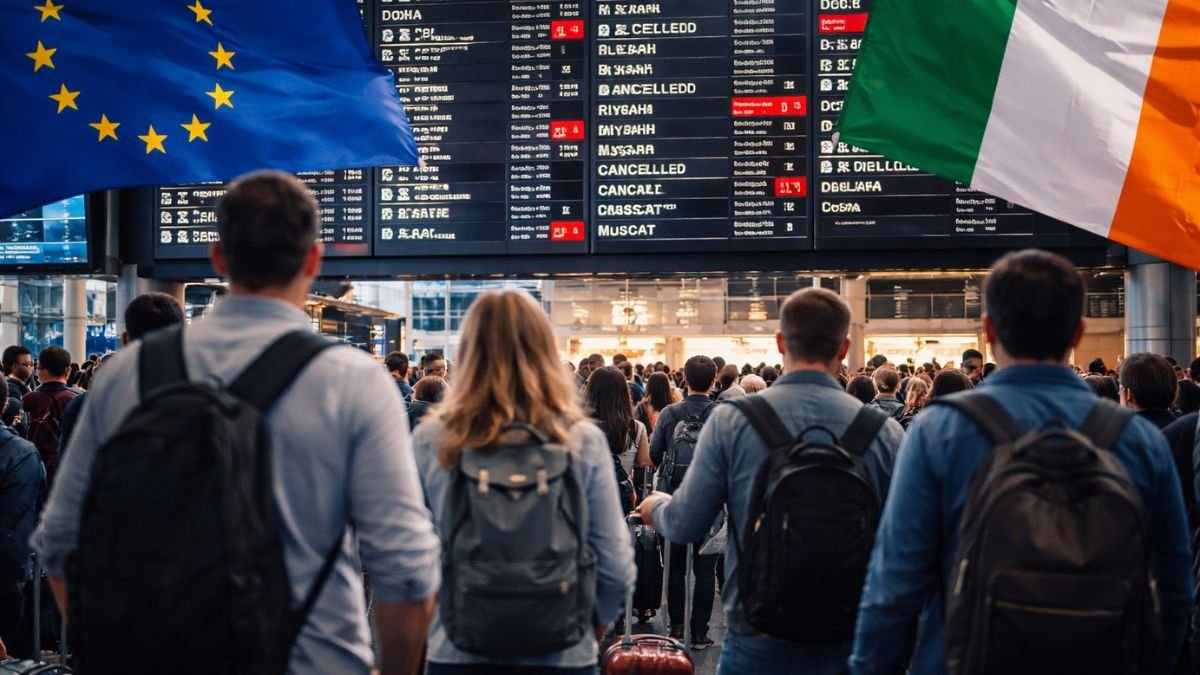
Air travel between Europe, Asia, and beyond is facing major disruption after the European Union Aviation Safety Agency (EASA) expanded its conflict zone advisory.
Countries including Ireland, Sweden, Germany, France, Italy, and Spain are now enforcing stricter aviation safety measures, impacting global flight operations.

The advisory, issued under CZIB 2026-03-R6, identifies multiple Middle Eastern airspaces as unsafe for civil aviation at all altitudes, forcing airlines to reroute, delay, or cancel flights.
Which Airspaces Are Affected?
The advisory covers key aviation corridors across the Middle East, including:
- Iran
- Iraq
- Israel
- Jordan
- Kuwait
- Lebanon
- Oman
- Qatar
- United Arab Emirates
- Saudi Arabia
- Bahrain
These regions are critical transit routes for long-haul flights connecting Europe with Asia and Australia. Their restriction has created widespread operational challenges across global airline networks.
Why the Advisory Was Issued

The updated directive reflects heightened safety risks due to escalating military tensions in the region.
Authorities have highlighted several concerns:
- Increased military activity and air defence operations
- Risk of missile activity and airspace instability
- Possibility of civilian aircraft misidentification
The classification of “no safe altitude” is rare and indicates that all levels of air travel—low to high altitude—are considered unsafe.
Impact on Airlines and Flight Routes

Airlines operating across Europe and internationally are now required to avoid affected airspace entirely. This has led to:
- Flight rerouting through longer northern or southern corridors
- Extended travel times of up to four hours
- Increased fuel consumption and operational costs
- Reduced aircraft availability and scheduling efficiency
Many flights are now being redirected via Central Asia or Africa, significantly altering traditional routes.
Delays, Cancellations, and Network Strain
The restrictions have triggered a wave of disruptions across global aviation:
- Increased flight delays and cancellations
- Reduced flight frequency on key routes
- Congestion in alternative airspace corridors
- Missed connections and longer layovers for passengers
As airlines converge on fewer safe routes, congestion is intensifying, creating bottlenecks across the global aviation system.
Rising Costs and Airfares
The financial impact of these disruptions is already being felt.
Key cost drivers include:
- Higher fuel usage due to longer routes
- Increased crew and operational expenses
- Reduced seat availability
As a result, airlines are passing these costs on to passengers, leading to rising ticket prices—particularly on long-haul routes between Europe and Asia.
Effects on Global Travel and Tourism
The advisory is not only affecting airlines but also global tourism and trade.
- Travel demand to affected regions is declining
- Air cargo operations are experiencing delays
- Supply chains are facing increased transportation costs
- Global connectivity is being reduced
Major Middle Eastern transit hubs are also seeing reduced efficiency, impacting their role in international travel networks.
What Travellers Should Expect
Passengers traveling on affected routes should prepare for ongoing uncertainty.
Recommended steps include:
- Monitoring flight updates regularly
- Booking flexible tickets where possible
- Considering alternative routes or travel dates
- Reviewing travel insurance coverage
Airlines are providing updates, but conditions remain fluid due to the evolving geopolitical situation.
Conclusion
The expansion of the EU conflict zone advisory marks one of the most significant aviation disruptions in recent years.
With multiple Middle Eastern airspaces deemed unsafe, airlines are being forced to reroute flights, resulting in delays, cancellations, and rising costs.
As long as geopolitical tensions persist, global air travel is likely to remain under pressure. Travellers and airlines alike must adapt to a new reality of longer routes, higher fares, and increased uncertainty.